Kimball Pearsons
10th New York Cavalry, Co. L, 1861-1864
Collins, NY
This site was created by History 495 intern Andrea Certo in the Spring 2026 semester.
These pages take you on Kimball Pearson' journey from his home in Collins, N.Y. to his death in Virginia. They follow his path through the vehicle of his letters as he describes his experiences in the American Civil War. |
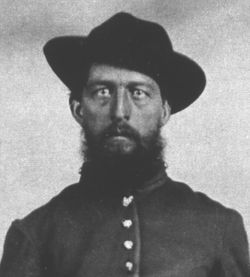 |
We are grateful to David B. Russell for donating the Kimball Pearsons Collection to the St. Bonaventure University Archives. Russell is the author of Tough and Hearty a collection Pearsons' letters.
The site is based on scans and transcripts created by Research Arsenal. We are very grateful for the work they did in processing the collection. |
Intern Andrea Certo wrote this autobiography from Pearsons' point of view:
My name is Kimball Pearsons and I served my Union in this War of Rebellion. I went on campaign from my home in Upstate New York to the battlefields of Virgnia.
Biography:
I was born in the town of Collins, New York in 1831 as the son of Mary Bartlett and and Amos Pearsons. I had an older sister born named Harriett born in 1829 and received my education at a school not far from my home. After my father's death in 1850, I assumed ownership of my family farm; grew some crops and raised some animals. In 1861, I married my Betsy Harris and we enjoyed only a year together. She died in June 1862 from consumption [tuberculosis] which left me devastated. It was while grieving this personal loss that I made the decision to enlist. In August 1862, I made my way to Elmira and enlisted in Co. L of the New York 10th Cavalry. My story serves as a testament of what life on campaign entails. This will make for an entertaining narrative I suppose, but I hope that anyone reading this never has the obligation to march on campaign to face the horrors of war like myself and my fellow comrades.
Jan- Nov 1863 Letters
| General Franklin's Headquarters: 1 Jan 1863 |
Bell Plains Landing 11 -16Jan 1863 |
| Camp Bayard, VA; 19 Jan- 4 Feb 1863 |
King Georges Courthouse, VA: 16 Feb 1863 |
| Camp Bayard, VA: 28 Feb- 6 March 1863 (Union Church) |
Camp Bayard, VA: 8 March- 27 March 1863 |
| On picket between the Rappahannock & King Georges Courthouse: 6-8 April 1863 |
Camp Bayard, VA: 12 April- 14 1863 |
| Warrenton Junction, VA: 19-28 April 1863 |
Bealton Station, VA: 9-12 May 1863 |
| On picket at Rappahannock Station & Alexandria R.R.: 20-28 May 1863 |
Warrenton Junction, VA : 1-11 June 1863 |
| Aldie & Edwards Ferry, VA: 19-27 June 1863 |
Gettysburg to Quincy, PA, 5-8 July 1863 |
| Bristoe & Bealton Stations, VA: 22-29 July 1863 |
Amissville to Sulphur Springs, Va.
August 3-11, 1863 |
| Bristoe & Catlett's Stations, Va., August 19-23, 1863 |
Sulphur Springs, VA, Aug. 27-Sept. 11, 1863 |
| Rapidan, VA: 22 -24 Sept 1863 |
Beverly Ford to Fairfax Station, VA, Sept. 30-Oct. 17, 1863 |
| |
Between Fairfax Station & Bullrun Creek, VA: 18 Oct 1863 |
| Fayetville, VA: 31 Oct 1863 |
Union Grove Church, VA: 12 Nov 1863 |
| Union Grove Church between Morrisville& Hartwood Church, VA: 16 Nov 1863 |
Union Grove Church, VA: 21 Nov 1863 |
Dec 1863- June 1864 Letters
| Sheperds Grove, VA: 8 Dec 1863 |
Diary Entry 14 Dec 1863 |
| Bealton, VA: 14 Dec 1863 |
Warrenton, VA: 22 Dec 1863- 1 Feb 1864 |
| Mount Pleasant Hospital , Washington D.C.: 10-14 Feb 1864 |
Warrenton, VA: 21 Feb- 26 April 1864 |
| Kellies Ford, VA: 30 April 1864 |
Harrison's Laning, James River: 15 May 1864 |
| Hanover Junction, VA: 26 May 1864 |
Bottoms Ridge, Chickahomminy River: 3-4 June 1864 |
| Chester Ferry, VA: 7 June 1864 |
Final Letter written by me before my death at Trevilian Station |
1864 Letters Post- Pearsons' death
| Collins, NY 4-9 June 1864 |
10 June, 1864 |
| Mount Pleasant Hospital, Washington D.C., 12 June 1864 |
Wilsons Landing, VA: 26 June 1864 |
| Envelope postmarked: 14 Jul 1864 |
Cortland Village, NY: 5 Sept 1864 |
| Headquarters of the New York 10th: 9 Mar 1865 |
In December 1862, myself along with the rest of Company L served as guards for General Smith and his staff at the battle of Fredericksburg. We came under fire from heavy rebel artillery but fortunately, none of us were wounded. While we weren't fighting the enemy, we'd often live our lives on campaign. This entailed us battling ilness, the certainty that any day that the enemy could attack us at any moment.We also lived off the land by gathering bundles of cedar wood brush or pine and lining the ground of our tents with it to sleep on. Next, a couple of rubber blankets went on top of the wood to form the base of the bed. We'd then line the rubber blankets with 4 woolens before we removed our boots and our overcoats as pillows.
In June 1863, General Lee defeated Major General Joseph Hooker at Chancelorsville. He took his Army of Northern Virginia northward and invaded the northern states in aiming to achieve an another victory and force an end to the war. They ended up in Gettysburg, Pennsylvania. The New York 10th Cavalry was part of the Union response to this development. We marchd out of Virginia and into Pennsylvania in late June and soon made it to Gettysburg.We fought on the second day of the battle; my company and company H were ordered to relieve a line of Union skirmishers on Brinkerhoff Ridge. On the battle's third day, we were kept in reserve but came under artilery fire.
In June 1864, General Grant sought to cut supply lines around the Condeferate capital of Richmond. However, moving the Army of the Potomac would leave him vulnerable to a Confederate counter attack if they crossed the Chickahominy and James Rivers. To prevent his, Grant sent General Sheridan to distract the Confederates. This led to my regiment and myself fighting at the battle of Trevilian Station, the largest full-scale cavalry battle in all of the War of Seccession. I fought bravely for the Union in trying to subdue the rebel southern states. However, just as this fate befell many other of my comrades, I was mortally wounded.
Before I took my final breath, I reflected on my time in the service, I am glad I enlisted, hope our cause may succeed and firmly believe it will and that slavery will be done away and that the old flag shall fly once more. Were it not for this terrible pain, it would be pleasant to die. Ultimately, my time in the service exposed me to what life was like on military campaign. From my home in western New York to Trevilian Station in Virginia, what I did was the job of trying to put down the rebellion of southern states.
Sources:
Letters from Kimball Pearsons 1862-1864, donated by David B. Russell
"Gettysburg" American Battlefield Trust
Kimball Pearsons- https://www.findagrave.com/memorial/3003878/kimball-pearsons
David B. Russell, Tough and Hearty (2012, Heritage Books).
https://www.louisahistory.org/product-page/map-1864-first-and-second-days-of-the-battle-of-trevilian-station
W. G. Ryckman. “Clash of Cavalry at Trevilians.” The Virginia Magazine of History and Biography 75, no. 4 (1967): 443–58. http://www.jstor.org/stable/4247344.
SBU Archives Civil War Index
St. Bonaventure University Archives
This
site was created by History 495 intern Andrea Certo during Spring 2026 semester.